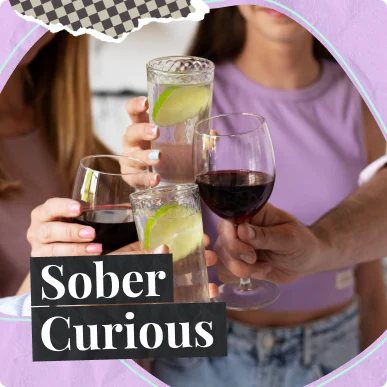
Last summer, I watched a friend order a sparkling water at a rooftop bar in the West Village. Not apologetically. Not with an explanation. She just ordered it, held the glass, and stayed in the conversation like nothing had happened.
Three years ago, that same move would have triggered a round of questions. Now nobody blinked.
Something has quietly changed about how we drink, or more accurately, about how we decide whether to.
The Shift Nobody Announced
This didn't start with a wellness campaign or a viral moment. It started when people woke up Sunday morning and did the math. The wine at dinner, the round of cocktails after, the nightcap that wasn't necessary. Then the foggy Monday, the low-grade anxiety, the two days of eating clean just to feel normal again.
The math stopped adding up.
"Sober curious" is the phrase that stuck, though it's a little clumsy. What it really describes is a growing group of people who haven't quit drinking but have started asking why they're doing it. That question, once you let it in, is hard to un-ask.
It isn't a sobriety movement. There's no chip, no meeting, no identity shift required. It's quieter than that, and that's exactly why it spread.
What Changed at the Bar
For years, the non-alcoholic options at most bars were an afterthought. Soda water with lime if you were lucky. Something called a "mocktail" that tasted like sugar and effort and still cost twelve dollars.
Then the actual products started improving. Dramatically.
Seedlip came first, arriving from the UK with botanical distillates and a design language that looked better on a back bar than most spirits. It didn't try to taste like booze. It tasted like something else entirely, herbs and citrus and earth, and that honesty was part of what made it work. It gave bartenders something to build with.
Ritual Zero Proof followed a different path, making direct substitutes for whiskey, tequila, and gin. The positioning was about the ritual, the pour, the glass, the garnish, and keeping that intact without the alcohol. Not the same as the real thing, but close enough that the experience of drinking socially didn't have to disappear with the ABV.
Then Ghia arrived and changed the conversation again. The brand was built around a single aperitif-style bottle with a look that belonged on a design-forward kitchen shelf. The founder, Melanie Masarin, had worked at Glossier. The aesthetic sensibility showed. Ghia wasn't pretending to be a spirit. It was its own category, low-sugar, botanically complex, and positioned squarely at the dinner party crowd who cared how things looked as much as how they tasted.
The product was a signal. It said: not drinking can be stylish. That mattered more than anyone expected.
Why Now
There are a few things converging here, and none of them are about sobriety as a moral position.
Sleep tracking changed something. When people started looking at their HRV data the morning after even two glasses of wine, and watching their recovery scores drop in real time, the casual drink became a negotiation. The data wasn't judgmental. It was just honest.
The wellness conversation shifted the stakes too. People who spend real money on supplements, sleep, and training aren't willing to watch alcohol undo the work. It's not a values thing. It's just arithmetic.
And then there's the social permission structure, which is genuinely new. A critical mass of people are now openly moderating or abstaining in public, without apology or explanation. Once that's normal in your social circle, the pressure that used to surround not drinking evaporates. You don't need a reason. You just need a good drink in your hand.
That last part is where the product opportunity lives. Nobody wants to hold a sad glass at a party.
The Brands Getting It Right
Curious/AF, a non-alcoholic bottle shop based in New York, understood something early. The problem wasn't demand. The problem was discovery and context. They created an environment where someone curious about the category could be educated without feeling like they were entering a recovery space. The retail experience did the cultural work.
Kin Euphorics took a completely different angle. Instead of simulating alcohol, they leaned into adaptogens and nootropics and built a product around the idea of a social high that doesn't wreck your next morning. GABA, rhodiola, 5-HTP. The formulation was intentional, and the brand communicated it directly to people who already spoke that language.
What both brands understood is that the customer isn't someone who gave something up. They're someone who upgraded. That framing matters.
The Honest Reality
Not every non-alcoholic product is good. Some taste like watered-down juice with a serious marketing budget behind them. The category is crowded now, which means the gap between a well-formulated product and a poorly executed one is easy to taste.
The brands worth your attention share a few things in common. They don't oversell the experience. They're honest about what the product is and isn't. They care about the actual drink, not just the label. And they understand that the person ordering one at a dinner party wants to feel like they made a considered choice, not a consolation choice.
That's the whole game.
The Verdict
Sober curiosity isn't a trend in the sense that it will be replaced by something else next year. It's a recalibration. People are drinking less, thinking more deliberately about when and why, and the product world has finally caught up with enough options that choosing not to drink doesn't mean opting out of the social experience.
You can still have the glass. You just get to choose what's in it.
That's not a small thing. For a culture that built so much of its social life around alcohol as a default, it's actually a quiet kind of freedom.